
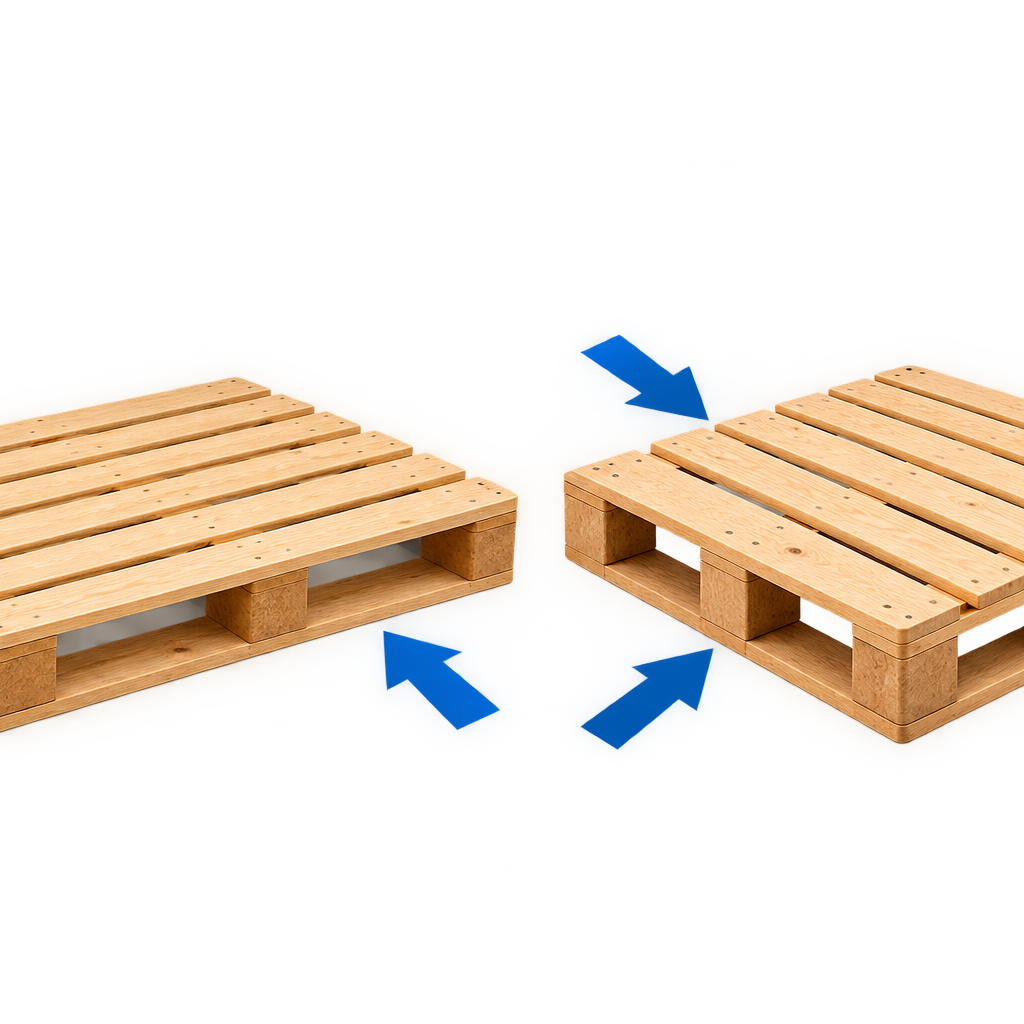
The way a forklift or pallet jack enters a pallet can have a significant impact on warehouse handling and shipping operations.
Two-way and four-way entry pallets are designed for different access configurations. Choosing between them depends on your material-handling equipment, warehouse layout, storage requirements, and shipping process.
What Is a Two-Way Entry Pallet?
A two-way entry pallet is designed to allow forklift or pallet-jack access from two opposite sides.
This can be an effective option when pallets are consistently moved in a particular direction and the warehouse or transportation process does not require access from all four sides.
What Is a Four-Way Entry Pallet?
A four-way entry pallet is designed to allow material-handling equipment to access the pallet from all four sides.
This can provide greater flexibility when pallets need to be approached from different directions.
A four-way entry pallet is designed to allow material-handling equipment to access the pallet from all four sides.
This can provide greater flexibility when pallets need to be approached from different directions.
Four-way entry can be particularly useful in environments with:
- Multiple forklift approaches
- Busy warehouse layouts
- Distribution centers
- Frequent pallet movement
- Flexible storage arrangements
What Is the Main Difference?
The primary difference is the direction from which material-handling equipment can access the pallet.
Feature
Two-Way Entry
Four-Way Entry
Entry directions
Handling flexibility
Suitable for consistent handling direction
Suitable for multiple approach directions
Warehouse flexibility
Two
More limited
Yes
Limited
Depends on layout
Four
Greater
Greater
Yes
Often greater
The exact performance of any pallet depends on its construction and application.
Are Four-Way Pallets Better?
Not automatically.
Four-way entry provides greater access flexibility, but that does not mean it is the best solution for every business.
If your operation consistently moves pallets from two directions, a two-way design may be sufficient.
The goal is to choose the pallet configuration that fits the actual material-handling process.
When Should You Choose a Two-Way Pallet?
A two-way entry pallet may be appropriate when:
- Forklifts approach from predictable directions
- Your warehouse layout supports two-direction handling
- The pallet design meets your load requirements
- Pallet movement is relatively consistent
- Your application does not require four-way access
When Should You Choose a Four-Way Pallet?
A four-way entry pallet may be appropriate when:
- Forklifts need access from multiple directions
- Pallets move through different warehouse areas
- Your facility uses different material-handling approaches
- Your distribution process requires greater flexibility
- You frequently reposition pallets
- Your facility uses different material-handling approaches
Consider Your Pallet Jack
Forklifts are not the only consideration.
If pallet jacks are used regularly, the entry configuration should be compatible with the equipment and the way operators move pallets through the facility.
Discuss your actual handling process with your pallet manufacturer before choosing a configuration.
What About Warehouse Racking?
Racking requirements should also be considered.
The pallet needs to work with the specific rack system, support configuration, load, and handling process.
A pallet that works well for floor storage may have different requirements when used in a rack-supported application.
Two-Way vs. Four-Way for Shipping
Shipping operations can benefit from flexible pallet access, particularly when pallets are loaded, unloaded, transferred, or repositioned multiple times.
However, the right design still depends on the complete shipping process.
Consider:
- Loading equipment
- Trailer configuration
- Warehouse layout
- Loading direction
- Unloading process
- Storage method
- Product dimensions
Can Pallet Entry Be Customized?
Yes. Pallet construction can be designed around the requirements of the application.
Businesses should provide information about their equipment, warehouse, product, load, and shipping process when discussing custom pallet requirements.
Frequently Asked Questions
A two-way entry pallet allows material-handling equipment to enter from two opposite sides.
A four-way entry pallet allows material-handling equipment to access the pallet from all four sides.
Entry configuration alone does not determine pallet strength. Strength depends on the overall pallet construction and application.
It depends on the warehouse layout, racking, handling equipment, and pallet movement. Four-way entry can provide more flexibility, but a two-way pallet may be sufficient for some operations.
International shipping requirements are separate from entry configuration. If wooden packaging is subject to ISPM-15 requirements, appropriate treatment should also be considered.
Need Help Choosing the Right Entry Configuration?
Viking Pallet manufactures wood pallet solutions for shipping, warehousing, manufacturing, and industrial applications.
Contact Viking Pallet with your product, handling, storage, and shipping requirements to discuss the right pallet configuration for your operation.