
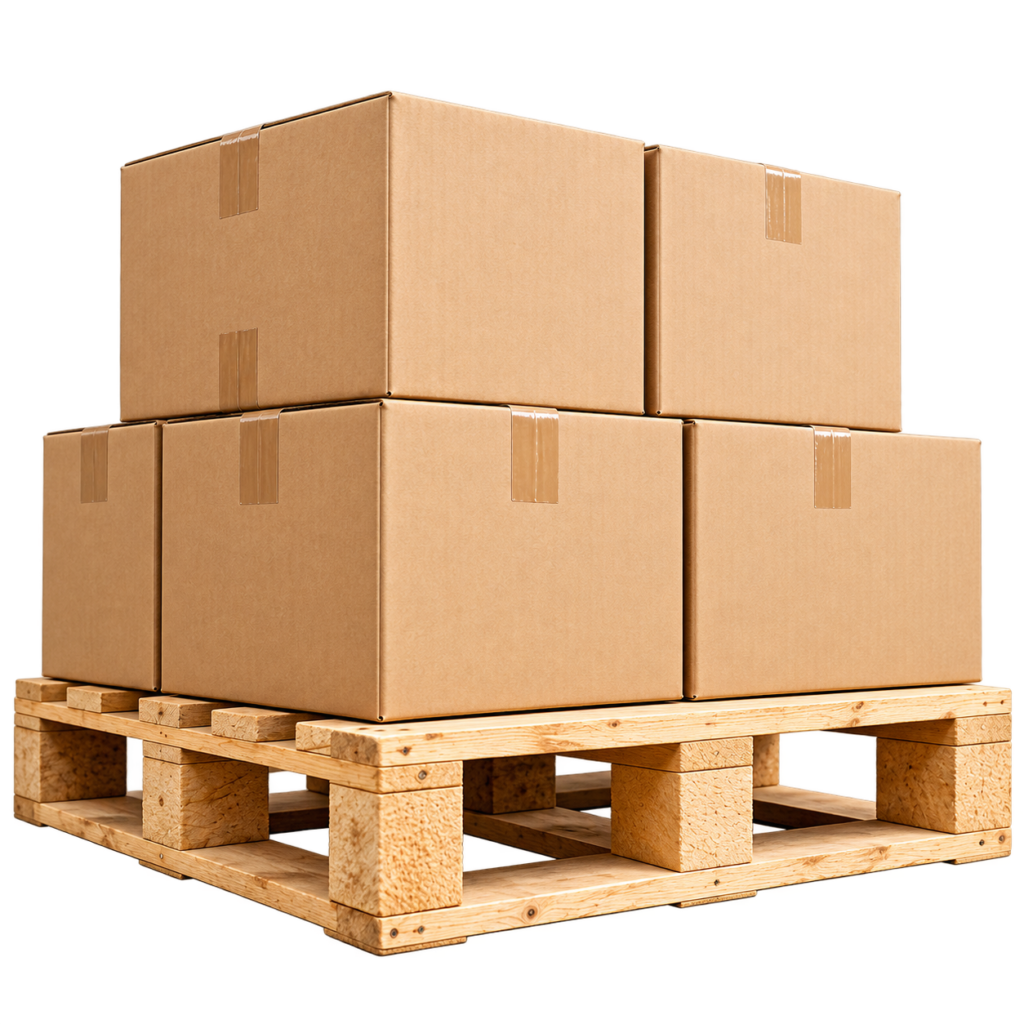
One of the most common questions businesses ask when purchasing wood pallets is:
How much weight can a wooden pallet hold?
There is no single weight limit that applies to every wood pallet. A pallet’s load capacity depends on its construction, dimensions, materials, load distribution, handling method, storage environment, and intended use.
For this reason, choosing a pallet based only on a general weight number can be misleading.
What Determines a Pallet's Load Capacity?
Several factors influence how much weight a pallet can safely support.
Several factors influence how much weight a pallet can safely support.
Pallet Construction
The way a pallet is constructed affects its ability to support a load.
Important components include:
- Deck boards
- Stringers
- Blocks
- Fasteners
- Overall pallet dimensions
- Support spacing
A pallet designed for a demanding application may require a different construction from one intended for lighter products.
1. Total Load Weight
The first factor is the total weight being placed on the pallet.
However, knowing the total weight alone is not enough.
For example, a concentrated heavy load may place significantly different stresses on a pallet than a lighter load distributed evenly across the entire deck.
2. Weight Distribution
How the product’s weight is distributed matters.
A pallet carrying a load evenly across its surface may behave differently from one carrying concentrated weight in a small area.
When ordering pallets, provide information about the shape and weight distribution of your products whenever possible.
How the product’s weight is distributed matters.
A pallet carrying a load evenly across its surface may behave differently from one carrying concentrated weight in a small area.
When ordering pallets, provide information about the shape and weight distribution of your products whenever possible.
3. Pallet Dimensions
The length and width of the pallet can affect its structural requirements.
A larger pallet may require different support and deck configurations than a smaller pallet.
This is one reason why pallet design should be considered together with the product being shipped.
4. Storage Conditions
How the pallet will be stored can also affect its requirements.
For example, a pallet stored on a warehouse floor may experience different support conditions from a pallet stored in a racking system.
Businesses should tell their pallet manufacturer how the loaded pallet will be stored.
5. Racking Requirements
If pallets will be placed in warehouse racks, the type of racking and support configuration should be considered during pallet selection.
A pallet that works for floor storage may not necessarily be appropriate for every rack configuration.
Always provide your racking requirements when ordering pallets for warehouse storage.
6. Handling Equipment
Forklifts, pallet jacks, conveyors, and automated handling systems can place different demands on pallets.
The pallet should be designed with the actual handling process in mind.
Static vs. Dynamic Load Capacity
Pallet capacity can also vary depending on whether the pallet is stationary or being moved.
Static Load
A static load refers to a pallet supporting a load while it remains stationary.
Dynamic Load
A dynamic load refers to a pallet supporting a load while it is being moved or handled.
The same pallet can have different performance characteristics depending on how it is used.
How Do You Choose a Pallet for a Heavy Load?
Start by identifying:
- Product weight
- Weight distribution
- Pallet dimensions
- Handling equipment
- Expected reuse
- Product dimensions
- Storage method
- Racking requirements
- Shipping conditions
- Required quantity
A pallet manufacturer can use this information to help determine an appropriate pallet construction.
Should You Use a Custom Pallet for Heavy Products?
A custom pallet may be appropriate when:
- The product is unusually heavy
- The load has unusual dimensions
- Weight is concentrated in specific areas
- The pallet needs specialized support
- The product requires special handling
- Standard pallet designs do not meet the application
Custom design allows the pallet to be developed around the actual load instead of relying on a generic specification.
How Viking Pallet Can Help
Viking Pallet manufactures standard and custom wood pallets for a wide range of business and industrial applications.
When discussing your pallet requirements, provide as much information as possible about your product, load, handling equipment, storage environment, and shipping process.
This allows the pallet design to be considered in the context of the actual application.
Frequently Asked Questions
There is no universal weight limit for all wooden pallets. Capacity depends on the pallet’s construction, dimensions, materials, load distribution, storage conditions, and handling method.
Not necessarily. Pallet design depends on more than product weight. Dimensions, weight distribution, handling, storage, and support requirements should also be considered.
It depends on the pallet design and the specific racking system. Racking requirements should be discussed with the pallet manufacturer before selecting the pallet.
A custom pallet can be beneficial when a heavy or unusual load has requirements that a standard pallet cannot adequately address.
Provide your pallet manufacturer with the product dimensions, weight, weight distribution, handling method, storage conditions, racking requirements, and shipping needs.
Need a Pallet for a Heavy or Specialized Load?
Viking Pallet can help you evaluate your pallet requirements and determine whether a standard or custom wood pallet is appropriate for your application.
Contact Viking Pallet to discuss your product and load requirements.