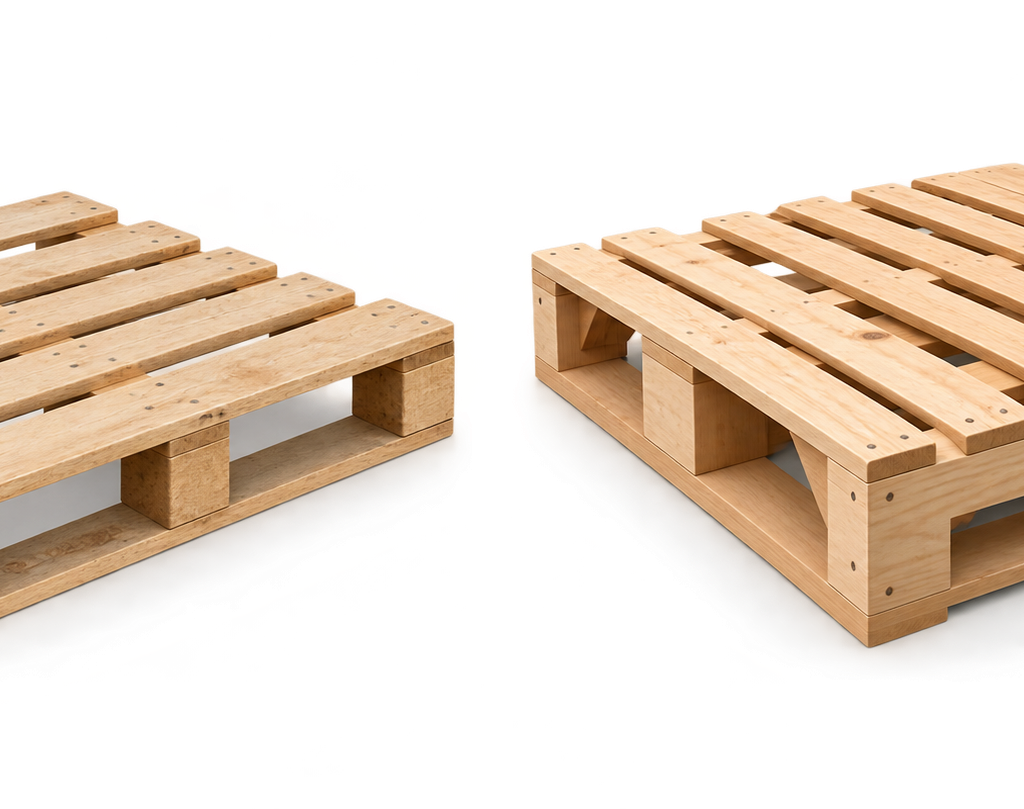
Businesses often have to decide whether to purchase a standard wood pallet or invest in a custom pallet design.
The right choice depends on your product, dimensions, weight, handling equipment, storage environment, shipping process, and order requirements.
A standard pallet can be an efficient solution for common applications, while a custom pallet may be more appropriate when your products or operations have specific requirements.
What Is a Standard Pallet?
A standard pallet follows an established size and construction configuration commonly used for shipping, storage, or material handling.
Standard pallets can be useful when your products fit an established pallet footprint and your handling and storage systems are already designed around it.
What Is a Custom Pallet?
A custom pallet is designed around the specific requirements of a product or business operation.
Custom pallet specifications can address:
- Length and width
- Product dimensions
- Product weight
- Deck configuration
- Shipping requirements
- Stringer dimensions
- Entry requirements
- Handling equipment
- Racking requirements
- Load distribution
When Is a Standard Pallet the Better Choice?
A standard pallet may be appropriate when:
- Your products fit common pallet dimensions
- Your warehouse already supports the pallet size
- Your handling equipment is compatible
- Your load requirements are straightforward
- You do not need specialized construction
- You regularly purchase the same pallet configuration
Standard pallets can simplify ordering and handling when your operation fits an established design.
When Should You Consider a Custom Pallet?
A custom pallet may be appropriate when your application has requirements that a standard pallet cannot adequately address.
Examples include:
Unusual Product Dimensions
Specialized Weight Requirements
If your product is particularly long, wide, tall, or irregularly shaped, a custom pallet can be designed around the product.
Products with concentrated or unusually heavy loads may require a specific pallet construction.
Special Handling Equipment
If your business uses particular forklifts, pallet jacks, conveyors, or automated handling systems, the pallet can be designed around those requirements.
Specialized Storage
Warehouse racking and storage systems can influence pallet dimensions and construction.
Product Protection
Some products may require a pallet configuration designed to provide better support and stability during transportation.
Custom Pallet Design Process
A good custom pallet starts with understanding the application.
Step 1: Understand the Product
The pallet manufacturer needs to know the product’s dimensions, weight, shape, and how it will be positioned.
Step 2: Understand the Handling Process
Determine how the pallet will be moved, including forklifts, pallet jacks, conveyors, or other equipment.
Step 3: Understand Storage Requirements
Consider warehouse floor storage, racking, stacking, and other storage conditions.
Step 4: Understand Shipping Requirements
Consider whether products will be shipped domestically or internationally and how frequently pallets will be handled.
Step 5: Develop the Pallet Design
The pallet can then be designed around the requirements identified during the process.
Custom vs. Standard Pallets: Key Differences
Factor
Standard Pallet
Custom Pallet
Dimensions
Design
Product requirements
Handling requirements
Storage requirements
Best suited for
Established
Standardized
Common
Standard
Standard
Common applications
Application-specific
Customized
Specialized
Can be customized
Can be designed around the application
Specialized applications
Does a Custom Pallet Always Cost More?
Not necessarily.
The cost of a pallet depends on many factors, including materials, dimensions, construction, quantity, and specifications.
A custom pallet should be evaluated based on the overall value it provides to the operation rather than simply comparing its price with a standard pallet.
For some applications, a properly designed pallet may improve product stability, handling efficiency, storage utilization, or shipping performance.
What Information Do You Need for a Custom Pallet?
When requesting a custom pallet, provide:
- Product dimensions
- Product weight
- Load distribution
- Desired pallet dimensions
- Quantity required
- Handling equipment
- Racking requirements
- Shipping destination
- Domestic or international use
- Reuse requirements
The more complete the information, the easier it is to develop a pallet that fits the actual application.
Viking Pallet Custom Pallet Manufacturing
Viking Pallet manufactures custom and standard wood pallets for businesses across a range of industries.
With manufacturing experience dating back to 1969, Viking Pallet works with customers to understand their product, handling, storage, and shipping requirements.
Frequently Asked Questions
Not always. Standard pallets can be ideal for common applications, while custom pallets are useful when specific product or operational requirements need to be addressed.
Consider a custom pallet when your product dimensions, weight, handling equipment, storage system, or shipping requirements do not fit a standard pallet effectively.
Yes. Racking requirements can be considered when developing a custom pallet design.
Yes. Pallet design can take product weight, weight distribution, dimensions, handling, and storage requirements into consideration.
Depending on the application and requirements, custom wood pallets can be manufactured with appropriate treatment for applicable international shipping requirements.
Need a Custom Pallet?
If a standard pallet does not fit your product or operation, Viking Pallet can help you explore a custom wood pallet solution.
Contact Viking Pallet with your product dimensions, weight, handling, storage, and shipping requirements.