
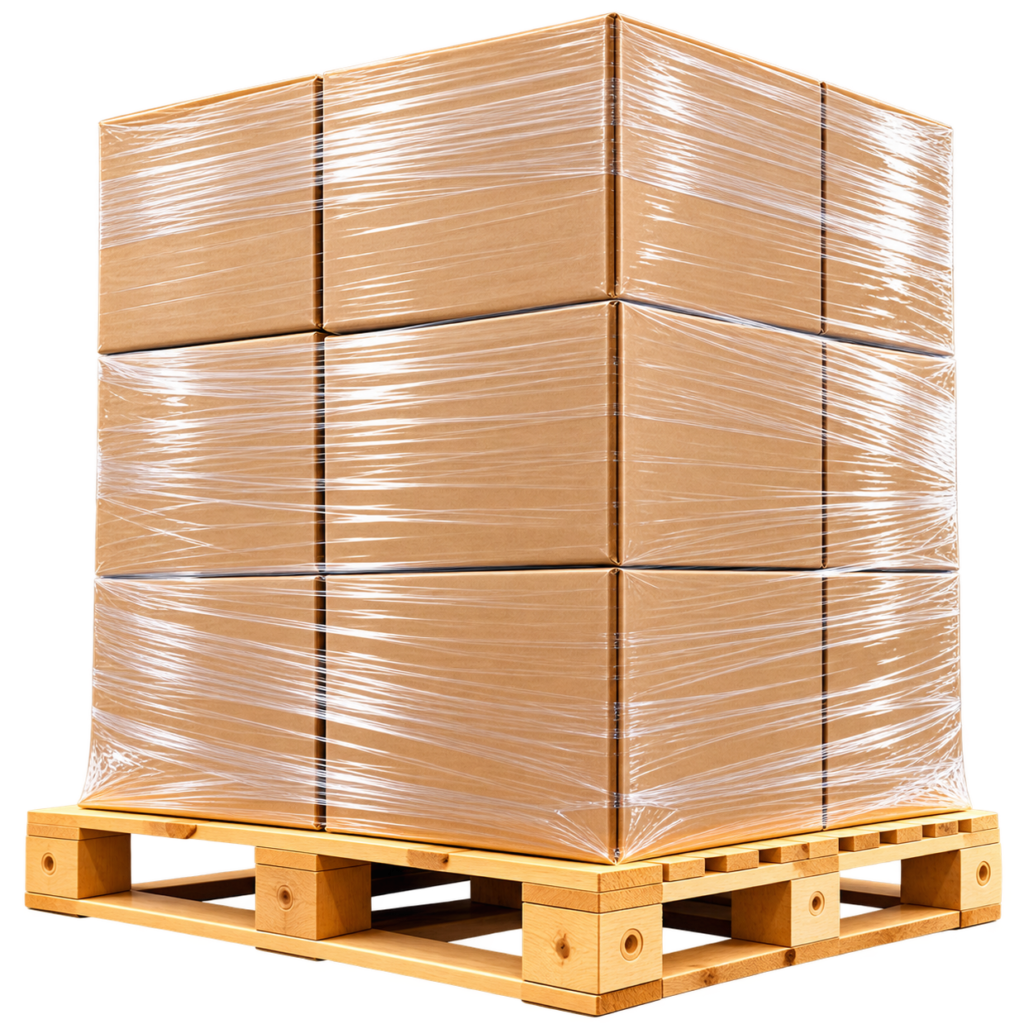
Choosing the right pallet size is an important part of product handling, warehousing, and transportation. The wrong pallet dimensions can create unnecessary product overhang, wasted space, handling problems, or storage limitations.
The best pallet size is determined by the product and the way the pallet will be used.
Start With Your Product Dimensions
The first step is to measure the product or packaged load.
Record:
- Length
- Width
- Height
- Weight
If several products will be placed on one pallet, determine the dimensions and total weight of the complete load.
The pallet should provide sufficient support for the load while fitting within the company’s handling and transportation requirements.
Consider Product Overhang
Product overhang occurs when the load extends beyond the edges of the pallet.
Depending on the product and pallet design, overhang may create additional risks or reduce load stability.
Whenever possible, the pallet footprint should be selected to provide appropriate support for the load.
However, the ideal configuration depends on the product and application.
Consider the Total Load Weight
Pallet size and pallet strength are related but are not the same thing.
A larger pallet is not automatically a stronger pallet.
Load requirements may affect:
- Stringer dimensions
- Number of deck boards
- Deck board thickness
- Pallet construction
- Entry configuration
- Overall pallet design
Tell your pallet manufacturer the maximum expected load weight rather than simply describing the product as “heavy.”
Check Your Handling Equipment
The pallet needs to work with the equipment used to move it.
Consider whether the pallet will be handled using:
- Forklifts
- Pallet jacks
- Conveyors
- Automated material-handling systems
You should also determine whether you need two-way or four-way entry.
Check Warehouse Racking Requirements
If pallets will be stored in warehouse racking, the pallet dimensions and construction need to be compatible with the rack system.
Before ordering pallets, verify the requirements of the warehouse.
Important considerations can include pallet dimensions, load weight, rack configuration, and how the pallet is supported.
Consider Transportation
Think about where the pallet will travel.
Will it be transported by:
- Truck
- Trailer
- Container
- Air freight
- Local delivery
- Distribution network
The pallet dimensions can influence how efficiently the product can be arranged during transportation.
Standard or Custom Pallet?
Once you understand the product requirements, determine whether a standard pallet will work.
A standard pallet may be appropriate when:
- The product fits comfortably
- The load is within the pallet’s intended application
- Handling equipment is compatible
- Warehouse requirements are satisfied
- Transportation requirements are satisfied
A custom pallet may be better when the product has unusual dimensions or requires specialized support.
Consider How Many Products Fit on Each Pallet
Pallet selection should consider the complete load configuration.
For example, determine:
- How many units fit per layer
- How many layers are required
- Total pallet height
- Total pallet weight
- Whether the load can be safely stacked
- Whether the load needs additional support
The goal is to create a stable and efficient unit load.
Consider Reusability
Some businesses use pallets once before they leave the supply chain, while others recover and reuse pallets.
If the pallet is expected to make multiple trips, its construction should be evaluated for the expected handling environment and reuse requirements.
Consider Heat Treatment
If pallets will be used for international shipping, determine whether heat treatment is required.
Heat-treated wood packaging may be required to meet applicable international phytosanitary requirements.
Your pallet manufacturer can help determine whether heat-treated pallets are appropriate for your shipping application.
Information to Give Your Pallet Manufacturer
To select the right pallet size, provide:
- Product length
- Product width
- Product height
- Product weight
- Number of products per pallet
- Packaging type
- Forklift requirements
- Pallet jack requirements
- Warehouse racking requirements
- Shipping destination
- Expected pallet quantity
- One-way or returnable use
The more accurate the information, the easier it is to evaluate the appropriate pallet design.
Viking Pallet Custom Pallet Solutions
Viking Pallet has manufactured wood pallets since 1969 and provides custom pallet design and manufacturing.
The company works with customers to develop pallet solutions based on product dimensions, weight, handling requirements, and other specifications.
Frequently Asked Questions
How do I know what pallet size I need?
Start by measuring your product or packaged load and determining its weight. Then consider handling equipment, warehouse racking, transportation, and shipping requirements.
Is a larger pallet always better?
No. The pallet should be appropriately sized for the product and application. A larger pallet may create unnecessary space or material requirements.
Should my product fit completely on the pallet?
In many applications, keeping the load appropriately supported by the pallet is preferable to excessive overhang. The exact configuration depends on the product and pallet design.
Should I use a standard or custom pallet?
Use a standard pallet when it meets your product and operational requirements. Consider a custom pallet when your product requires a specific size, construction, or configuration.
Conclusion
Selecting the right pallet size requires more than measuring the product. Businesses should consider load weight, product dimensions, handling equipment, warehouse racking, transportation, reuse, and shipping requirements.
By providing these details to a pallet manufacturer, you can develop a pallet solution that better fits your operation.
Viking Pallet provides standard and custom wood pallets designed for a wide range of manufacturing, warehousing, shipping, and distribution applications.