When choosing a wood pallet for shipping, warehousing, or manufacturing, one of the most common questions is whether to use a stringer pallet or a block pallet.
Both pallet designs can be effective, but they are constructed differently and can provide different handling and entry options. The right choice depends on your products, load requirements, material-handling equipment, storage environment, and shipping process.
What Is a Stringer Pallet?
A stringer pallet uses long wooden supports, called stringers, that run between the top and bottom of the pallet.
The stringers support the pallet deck and help distribute the load. Depending on the design, a stringer pallet can provide two-way or modified entry configurations.
Stringer pallets are commonly used for shipping, manufacturing, warehousing, and distribution applications.
What Is a Block Pallet?
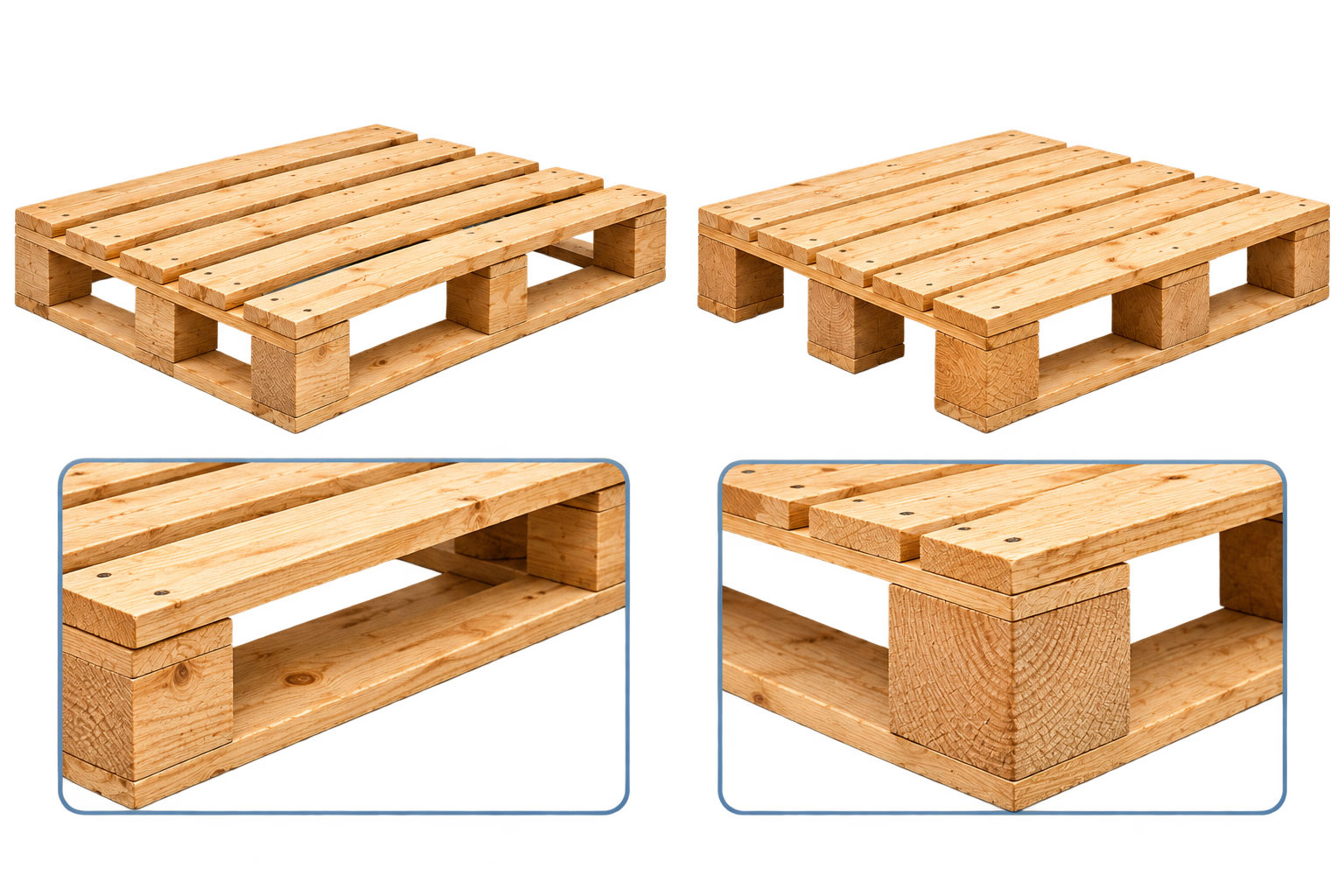
A block pallet uses individual wooden blocks between the upper and lower components of the pallet.
One of the primary advantages of many block pallet designs is four-way entry. This allows forklifts and pallet jacks to access the pallet from multiple directions.
Four-way access can provide additional flexibility in warehouses and distribution environments.
Key Differences Between Stringer and Block Pallets
Construction
Stringer pallets use continuous longitudinal supports, while block pallets use individual blocks to support the pallet structure.
Entry
Depending on their construction, stringer pallets may provide two-way entry, while block pallets are commonly designed for four-way entry.
However, pallet configurations can vary, so the specific design should always be confirmed with the manufacturer.
Material Handling
If your warehouse frequently approaches pallets from different directions, four-way entry may provide greater flexibility.
If your operation consistently handles pallets from two directions, a stringer pallet may be an appropriate solution.
Application
Neither design is automatically better for every business. The correct choice depends on how the pallet will be used.
Which Pallet Is Better for Heavy Loads?
The pallet’s overall construction matters more than simply choosing a stringer or block design.
Load capacity can be affected by:
- Product weight
- Weight distribution
- Deck board thickness
- Stringer or block construction
- Pallet dimensions
- Support spacing
- Rack configuration
- Handling equipment
- Intended use
For demanding applications, a custom pallet may be more appropriate than selecting a pallet based only on its general type.
Which Pallet Should You Choose?
Consider a stringer pallet when:
- Your handling process works well with two-way entry
- Your application fits a stringer pallet design
- You need a practical wood pallet for shipping or storage
- Your product and load requirements are compatible with the design
Consider a block pallet when:
- Four-way entry is important
- Your material-handling process approaches pallets from multiple directions
- Your warehouse benefits from flexible pallet access
- The block pallet construction is appropriate for your load
Does Viking Pallet Manufacture Both Types?
Viking Pallet manufactures wood pallet solutions for a variety of shipping, storage, manufacturing, and industrial applications.
If you are unsure whether a stringer or block pallet is appropriate for your operation, provide information about your product, weight, dimensions, handling equipment, and storage requirements. A pallet manufacturer can then help determine an appropriate design.
Frequently Asked Questions
Not necessarily. Strength depends on the specific pallet construction, materials, dimensions, load distribution, and intended application.
Many stringer pallet designs provide two-way entry, although configurations can vary.
Many block pallets are designed for four-way entry, but the exact configuration depends on the pallet design.
The appropriate pallet depends on how your forklifts approach and move pallets. Four-way entry can provide greater flexibility when pallets are accessed from multiple directions.
Yes. Pallet dimensions, deck configuration, materials, and other specifications can be customized based on the application.
Consider product dimensions, load weight, handling equipment, warehouse racking, entry requirements, shipping conditions, and whether the pallet will be reused.
Need Help Choosing a Pallet?
Viking Pallet can help businesses determine whether a standard or custom wood pallet is appropriate for their application.
Contact Viking Pallet with your product and handling requirements to discuss your pallet needs.